

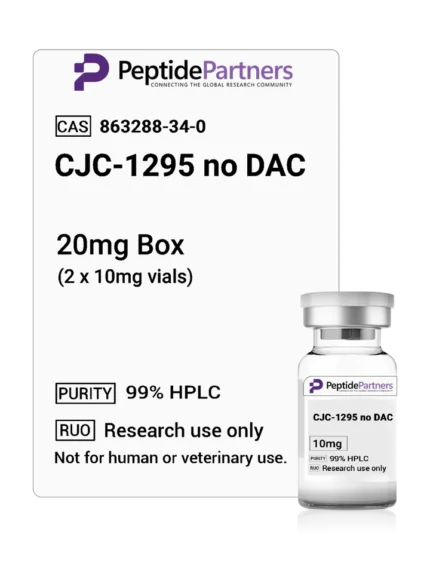

VIP (10mg vials)
Price range: $150.00 through $990.00
• Purity: 99.42% (multi-vial, independently tested)
• Format: 10mg vials (3 mL capacity)
• Box Options: 20mg, 50mg, 100mg, 200mg combinations
• Testing Status: Endotoxin & purity screening PASSED — Independently Certified USP<85> Endotoxin Safe
• Cost Efficiency: $4.95 – $7.50 per milligram
VIP (Vasoactive Intestinal Peptide) is a naturally occurring neuropeptide investigated for its role in ACE2/TMPRSS2 receptor modulation, circadian rhythm regulation, intestinal epithelial differentiation, and ADAM10-mediated receptor shedding in preclinical research. This research-grade material supports in-vitro experimentation focused on viral entry inhibition, SCN neuronal activity, p38 MAPK signaling, secretory cell differentiation, and epithelial regeneration mechanisms.
- Independent certificate details, manufacturer IDs, and batch IDs should be reviewed before purchase when available.
- Order cancellations for full refunds are available before shipment; shipped orders cannot be cancelled or refunded.
- For damaged or incorrect goods, photograph the outer packaging, inner packaging, and product labels, then email support within 48 hours of carrier delivery.
Buy VIP (Vasoactive Intestinal Peptide) – Peptide Partners
Product Overview & Specifications
VIP (Vasoactive Intestinal Peptide) is a naturally occurring neuropeptide investigated for its role in ACE2/TMPRSS2 receptor modulation, circadian rhythm regulation, intestinal epithelial differentiation, and ADAM10-mediated receptor shedding in preclinical research. Peptide Partners supplies this research-grade material for in-vitro testing, laboratory experimentation, receptor pharmacology, structural biology, and preclinical cellular research.
Published studies have examined VIP using cell culture models of SARS-CoV-2 entry, mouse suprachiasmatic nucleus (SCN) brain slice cultures, intestinal organoid systems, ADAM10 inhibitor assays, electrophysiological recordings, cAMP signaling pathway analyses, and radiation-induced injury models. Research areas include ACE2 and TMPRSS2 downregulation, receptor shedding mechanisms, VIPR2 receptor activation, PKA/Epac signaling, PER1 clock protein interactions, Kv3 potassium channel modulation, p38 MAPK pathway activation, and Lgr5+ progenitor cell regulation.
The product name supplied for this listing is “VIP (Vasoactive Intestinal Peptide).” Researchers should verify the exact identity, sequence, formulation, and batch-specific certificate of analysis before beginning any experiment. Findings from published VIP studies should not be assumed to apply to every commercial batch or formulation.
Product Specifications
| Specification | Details |
|---|---|
| Product name | VIP (Vasoactive Intestinal Peptide) |
| Compound type | Naturally occurring neuropeptide (28 amino acids) |
| Primary molecular targets | VIP receptors (VIPR1, VIPR2), ACE2, TMPRSS2, ADAM10 metalloprotease, p38 MAPK pathway |
| Primary research areas | Viral entry inhibition, circadian rhythm regulation, intestinal epithelial differentiation, receptor shedding, cAMP signaling, SCN neuronal activity, p38 MAPK pathway, and epithelial regeneration |
| Product format | 10 mg vials |
| Vial size | 10 mg |
| Vial capacity | 3 mL |
| Available box combinations | 20 mg, 50 mg, 100 mg, and 200 mg |
| Multi-vial purity | 99.42% |
| Independent testing | Yes |
| Endotoxin screening | Passed (USP<85> Certified Endotoxin Safe) |
| Purity screening | Passed |
| Manufacturer ID | SH07 |
| Batch ID | VP20250511 |
| Cost per milligram | $4.95–$7.50 |
The stated 99.42% purity is based on multi-vial testing. Researchers should review the batch-specific certificate of analysis before beginning any experiment.
Primary Research Studies & Findings
Vasoactive Intestinal Peptide (VIP) in COVID-19 Therapy—Shedding of ACE2 and TMPRSS2 via ADAM10
Authors: Charlotte Gutzler, Kerstin Höhne, Daniele Bani, Gian Kayser, Sebastian Fähndrich, Michael Ambros, Martin J Hug, Siegbert Rieg, Valeria Falcone, Joachim Müller-Quernheim, Gernot Zissel, and Björn C Frye
Publication: International Journal of Molecular Sciences, 2025
PMCID: PMC11942504
Reference: View publication
This in vitro study investigated the effect of Vasoactive Intestinal Peptide (VIP) on the expression of SARS-CoV-2 entry receptors, ACE2 and TMPRSS2, in cell cultures. The results demonstrate that VIP downregulates the transcription of both ACE2 and TMPRSS2 genes, leading to reduced protein expression on the cell surface. Furthermore, VIP was shown to induce the shedding of these receptors from the cell surface, a process mediated by the metalloprotease ADAM10.
This was confirmed by the observation that the ADAM10 inhibitor, Aderbasib, blocked the VIP-induced shedding. The functional consequence of these changes was a reduction in the proteolytic activity of TMPRSS2 and a decreased infection rate of cells by a SARS-CoV-2 pseudovirus. These findings suggest that VIP may inhibit SARS-CoV-2 cellular entry by a dual mechanism: reducing the expression and promoting the shedding of its entry receptors.
The research establishes a mechanistic link between VIP treatment, ACE2/TMPRSS2 receptor modulation, and reduced viral entry in laboratory models. The findings demonstrate VIP’s capacity to influence both receptor transcription and post-translational processing through ADAM10-mediated shedding.
Plain-English Research Summary
Scientists investigated how a natural peptide in our bodies, called VIP, might help fight off the virus that causes COVID-19. In laboratory experiments using cells, they discovered that VIP can make it harder for the virus to get into cells. It does this in two ways: first, it tells the cells to make less of the ‘doorknobs’ (receptors called ACE2 and TMPRSS2) that the virus uses to enter. Second, it helps to ‘cut off’ the doorknobs that are already on the cell surface, so the virus has nothing to grab onto. This one-two punch effectively reduces the number of entry points for the virus, making it more difficult for the cells to become infected.
Vasoactive Intestinal Peptide Produces Long-Lasting Changes in Neural Activity in the Suprachiasmatic Nucleus
Authors: Takashi Kudo, Yu Tahara, Karen L Gamble, Douglas G McMahon, Gene D Block, and Christopher S Colwell
Publication: Journal of Neuroscience, 2014
PMCID: PMC4073931
Reference: View publication
This study investigated the long-term effects of vasoactive intestinal peptide (VIP) on the electrical activity of neurons in the suprachiasmatic nucleus (SCN) using mouse brain slice cultures. Application of VIP induced a sustained increase in neuronal firing rate that persisted for several hours. This effect was mediated by the VIP receptor VIPR2, as it was blocked by a VIP receptor antagonist and absent in VIPR2 knockout mice.
The downstream signaling pathway involves the activation of both PKA and Epac, leading to an increase in cAMP. The study also demonstrated that the persistent increase in firing rate was dependent on the clock protein PER1 and the Kv3 potassium channels, suggesting that VIP regulates the fast delayed rectifier (FDR) potassium currents to produce long-lasting changes in SCN neuronal excitability.
The findings establish VIP as a key modulator of circadian clock neuronal activity through VIPR2-mediated cAMP signaling and PER1-dependent mechanisms. The research demonstrates that VIP influences both immediate neuronal excitability and sustained changes in firing patterns through Kv3 potassium channel regulation.
Plain-English Research Summary
Our internal body clock, located in a brain region called the SCN, controls our daily rhythms. A molecule called VIP is known to be important for the function of this clock, but how it works was not fully understood. In this study, researchers used slices of mouse brain tissue kept alive in a dish to study the effects of VIP on the brain cells of the SCN. They found that VIP caused a long-lasting increase in the electrical activity of these cells, making them fire more frequently for several hours. This effect was triggered by VIP binding to a specific receptor on the cell surface, which in turn activated a chain of chemical reactions inside the cell. The study also revealed that this process depends on a specific ‘clock gene’ and certain channels that control the flow of potassium in and out of the cells.
Vasoactive Intestinal Peptide Promotes Secretory Differentiation and Mitigates Radiation-Induced Intestinal Injury
Authors: Tatiana Agibalova, Anneke Hempel, H Carlo Maurer, Mohab Ragab, Anastasia Ermolova, Jessica Wieland, Caroline Waldherr Ávila de Melo, Fabian Heindl, Maximilian Giller, Julius Clemens Fischer, Markus Tschurtschenthaler, Birgit Kohnke-Ertel, Rupert Öllinger, Katja Steiger, Ihsan Ekin Demir, Dieter Saur, Michael Quante, Roland M Schmid, and Moritz Middelhoff
Publication: Cellular and Molecular Gastroenterology and Hepatology, 2024
PMCID: PMC11462795
Reference: View publication
This study demonstrates that Vasoactive Intestinal Peptide (VIP) promotes the differentiation of intestinal epithelial cells towards a secretory phenotype, a process mediated by the p38 MAPK pathway. In vitro experiments using intestinal organoids revealed that VIP modulates the proliferation of Lgr5-EGFP+ progenitor cells under homeostatic conditions. Furthermore, in a model of radiation-induced intestinal injury, VIP was shown to enhance epithelial regeneration.
The study found that irradiated Lgr5-EGFP+ progenitor cells were more susceptible to VIP-induced modulation, which promoted their regenerative capacity. These findings suggest that VIP plays a crucial role in maintaining intestinal homeostasis and mitigating radiation-induced damage by promoting secretory differentiation and epithelial regeneration.
The research establishes p38 MAPK signaling as a key pathway mediating VIP’s effects on intestinal epithelial differentiation. The findings demonstrate that VIP influences both progenitor cell proliferation and regenerative responses to injury in intestinal organoid models.
Plain-English Research Summary
Scientists studied how the peptide VIP affects intestinal cells grown in a lab. They found that VIP encourages these cells to become specialized ‘secretory’ cells, which are important for a healthy gut lining. They also discovered that VIP helps the gut’s stem cells to grow and multiply. When the intestinal cells were damaged by radiation, VIP helped them to heal and regenerate more effectively. This suggests that VIP could be a potential treatment to protect the intestines from damage caused by radiation therapy.
Standard Research Disclaimer
Research Use Only. Not for use in diagnostic tests.
This product is solely intended for research purposes as a chemical compound. It is designated exclusively for in-vitro testing and laboratory experimentation. All information provided about this product is educational and should be evaluated by appropriately qualified research personnel.
By law, bodily introduction of this product into humans or animals is strictly prohibited. This compound must not be used, administered, or represented as a drug, food, dietary supplement, COVID-19 treatment, circadian rhythm treatment, intestinal treatment, radiation protection, diagnostic material, or medical treatment. It is not intended to diagnose, treat, cure, or prevent any disease. It should be handled only by licensed and qualified professionals in an appropriately equipped laboratory and in accordance with applicable laws, institutional procedures, and relevant safety requirements.
| Choose pack |
2 vials × 10mg (20mg total) ,5 vials × 10mg (50mg total) ,10 vials × 10mg (100mg total) ,20 vials × 10mg (200mg total) |
|---|
- All of our manufacturing partners produce peptides using the Lyophilization (Freeze Drying) process, ensuring products maintain stability for shipping and storage for 12+ months.
- In lyophilized form, they are shelf-stable for many weeks. However, for long-term storage, it is recommended to store them in the freezer.
- We often hear concerns about the standard "discard after 28 days of first use" disclaimer. Don't worry, this has nothing to do with studies regarding the efficacy of specific peptides. 28 days is the FDA requirement for producers of multi-use vials to prove their bacteriostatic maintains efficacy. This minimum requirement becomes the de facto standard.
- In our experience, if you use proper sterile procedures and refrigerated storage, you can continue sampling from the same reconstituted vial for 3+ months.
Certificate records
No published certificate records are available for this product.
Search Certificate LedgerRelated products
